The sacroiliac joints connect the sacrum (the wedge-shaped bone at the bottom of the spine) to the iliac bones (the two bones that make up the pelvis). These joints support the weight of the body when we are upright, so to provide stability there is only a small amount of movement available at these joints. They are also the strongest joints in the body.
Patients with sacroiliac joint dysfunction can feel pain in the lower back, buttocks, groin and thighs; however, it does not typically radiate below the knee. The pain is typically worse on weightbearing or on transitional movements, such as sitting to standing, or rolling over at night
There is commonly a history of trauma, such as landing heavily on one buttock or one foot that shears the sacroiliac joint. Any condition that alters the normal walking pattern, such as an osteoarthritic knee or a leg length discrepancy may place increased stress on the sacroiliac Joints. A repetitive one-sided motion such as bowling a cricket ball can also cause the sacroiliac joints to become dysfunctional. These joints also under go changes in females during pregnancy that can lead to dysfunction and pain (pelvic girdle Pain (PGP)/ symphysis pubis dysfunction (SPD), also known as post-partum Pelvic Pain (PPPP).

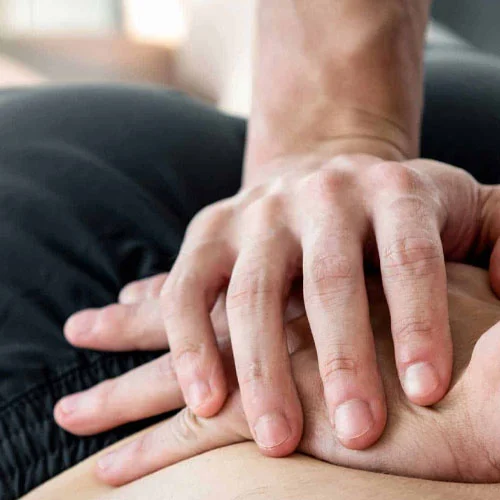
A thorough examination by a manual therapist (physiotherapist, osteopath or chiropractor) or a specialist doctor will identify whether it is likely that the pain is originating from the sacroiliac joint, or elsewhere. Our physiotherapist, osteopaths and chiropractors are all trained to pick up subtle abnormalities in the way your sacroiliac joints are positioned and moving.
You can see any of our practitioners for most conditions but check out their profiles for more information and specific interests. Dr Simon Petrides, and our MSK pain doctors see difficult cases which are unresponsive to physical therapies and use injections such as prolotherapy, cortisone injections, diagnostic injections or radiofrequency denervation. Platelet rich plasma is also becoming popular for this condition.
Check out our services pages to find out more about these therapies. Practitioners are trained to treat most conditions but do this in slightly different ways. They work together to find the best treatment most suited to your condition.
Blackberry Clinic has experienced specialist doctors and therapists working together to diagnose and choose the most appropriate treatment for your pain. See below for treatments available for SI joint pain. You will have a thorough assessment to decide what is the best treatment pathway for your condition.
It would not be an exaggeration to say that Lorena has changed my life. Four months ago, having been diagnosed as having “severe, acute and chronic” disc degeneration I genuinely thought I was facing a life of disability (I am 49).
Lorena has re-taught me how to move my body and how to think about what muscles I engage to a point that I am now running, swimming and doing pilates again and have almost full flexibility in my spine. It almost feels like Lorena can see through your skin to your muscles, so profound is her understanding of how the body moves.
After a course of Prolotherapy my back pain has gone and I live a normal life. I can’t thank Dr Petrides enough for giving me back my quality of life
Just wanted to say please pass my thanks to my osteopath, I came yesterday with terrible back and shoulder pain and today I am pain free, am well delighted as had a day planned with friends was worried I wouldn’t enjoy, please pass my thanks onto her.
Following treatment at Blackberry Clinic, Milton Keynes my back pain improved and I could play for my country again
To find out more and find your local Bupa Clinic for a Bupa Health Assessment click here