The patellar tendon is located just below the kneecap. It connects the kneecap or patella to the tibia (shin bone). The quadriceps tendon inserts into the patella and works with the patellar tendon to extend the knee.
Inflammation of the tendon, or tendinitis, is most common in athletes whose sports involve frequent jumping, but people who don’t play any sport can get patellar tendinitis.
Physiotherapy treatment is often very successful but if persistent there are a lot of other treatments available, such as prolotherapy.
Patellar tendinitis is a common overuse injury, caused by repeated stress on your patellar tendon. This may be from increased activity, changing sports footwear, and muscle imbalances such as tight hamstrings or quads. The stress results in tiny tears in the tendon.
As more tears occur, they cause pain, inflammation and weakening of the tendon. Tendinopathy is the term used if the condition continues for more than a few weeks.
Pain at the front of knee is the first symptom of patellar tendinitis, usually between your kneecap and where the tendon attaches to your lower leg.
Initially, you may only feel pain in your knee as you begin exercising or after vigorous exercise. Over time, the pain may get worse and start to interfere with playing your sport. Eventually, the pain interferes with every day activities such as climbing the stairs, getting up from a chair etc.
Swelling or redness around a joint is a red flag symptom and if you have this, please see a doctor as soon as possible.

Our Blackberry Clinic practitioners and doctors will do a thorough assessment of your knee and how you walk or run, having taken a history of the nature of the pain, how it started, what makes it worse etc. A physical assessment will also help determine where the pain is coming from.
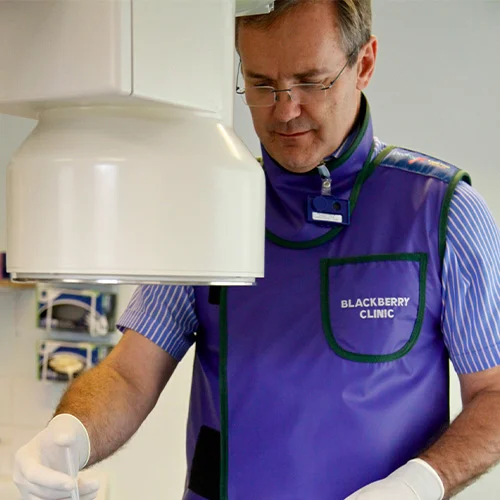
The doctor may use ultrasound to see if there are any tears in your patellar tendon. There are other diagnostic tests such as MRI or Xray which can be organised by the doctor if necessary.
If there is an imbalance in the biomechanics of your foot, this can affect your knee and other parts of your body. Correcting that imbalance with bespoke orthotics, such as Phits Orthotics, will neutralise the position of your foot and take the pressure off the knee and the patellar tendon. At Blackberry Clinic we offer a full gait analysis using Footscan technology so you can see for yourself how your foot is functioning and how orthotics might help.
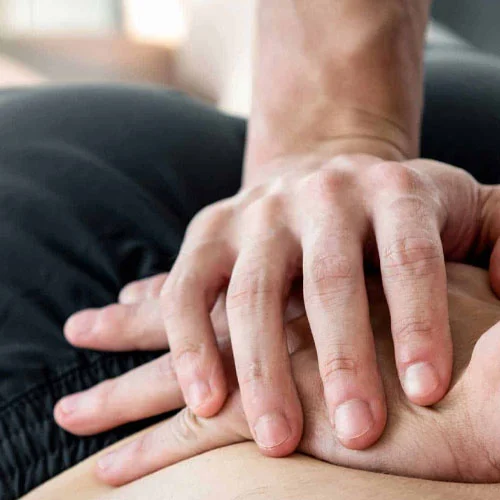
For mild cases, rest and ice can help reduce inflammation, along with physio prescribed specific strengthening exercises and PHITS orthotics if necessary. You may be taught how to tape your knee if playing sport and advised to cut down on training until the pain settles. For more stubborn cases our physios can refer you to one of the doctors for further investigation and treatment. Injection treatments include platelet rich plasma injections and prolotherapy.
It would not be an exaggeration to say that Lorena has changed my life. Four months ago, having been diagnosed as having “severe, acute and chronic” disc degeneration I genuinely thought I was facing a life of disability (I am 49).
Lorena has re-taught me how to move my body and how to think about what muscles I engage to a point that I am now running, swimming and doing pilates again and have almost full flexibility in my spine. It almost feels like Lorena can see through your skin to your muscles, so profound is her understanding of how the body moves.
Just wanted to say please pass my thanks to my osteopath, I came yesterday with terrible back and shoulder pain and today I am pain free, am well delighted as had a day planned with friends was worried I wouldn’t enjoy, please pass my thanks onto her.
After a course of Prolotherapy my back pain has gone and I live a normal life. I can’t thank Dr Petrides enough for giving me back my quality of life
Following treatment at Blackberry Clinic, Milton Keynes my back pain improved and I could play for my country again
To find out more and find your local Bupa Clinic for a Bupa Health Assessment click here