

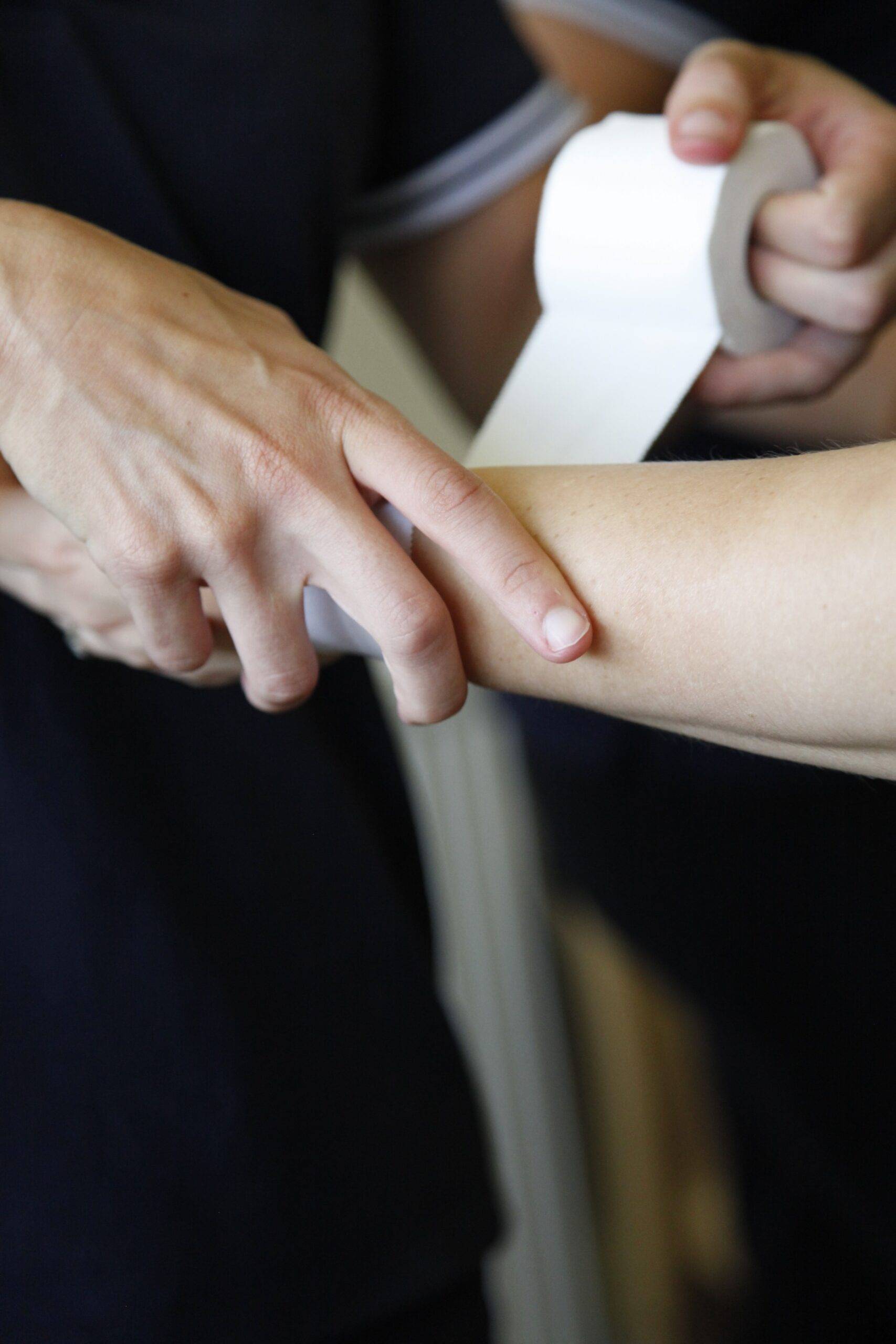
At Blackberry Clinic our practitioners and doctors can treat ligament, muscle and joint injuries. Often, diagnosis is key and there are 20 individual ligaments in the wrist alone. If you have a wrist sprain, make an appointment with one of our physios, osteopaths or chiropractors to get diagnosis and treatment. Depending on the injury, there are numerous treatments that might help. These include manual therapy, acupuncture, steroid injections, soft tissue massage and more. Thanasis, one of our physios at Blackberry Clinic Milton Keynes, has been doing some research to share with you about the hand and wrist.
The hand, positioned at the end of the upper limb, is a combination of complex joints whose function is to manipulate, grip and grasp, all made possible by the opposing movement of the thumb (2).
Some biologists believe that the development of the human hand lead indirectly to the development of our large and complex brain. The hand’s existence promoted brain development by allowing humans to manipulate, interact with, explore, and gain information from the environment. A more complex brain permitted us in turn to make and use tools and to develop language leading to an elaborate system of shared meanings, what we know as culture (2).
Musculoskeletal pain is a highly prevalent and costly health care problem globally. Wrist pain accounts for an annual consultation prevalence rate of 58 in 10,000 patients in the UK, and is the fourth most common site of musculoskeletal pain in the upper limb after the shoulder, hand and elbow. While Walker-Bone et al. have demonstrated that non specific hand and wrist pain has a prevalence of around 10% in the general population (1).
A wrist sprain is a common injury, particularly in work and athletic environments. An acute wrist sprain is an injury to a ligament often due to an acute traumatic event or chronic repetitive movements. There are 20 individual ligaments of the wrist connecting the eight carpal bones to each other as well as to the forearm and the hand. Some of these ligaments are more prone to injury than others, with location and dynamic function playing the most critical role in injury susceptibility (3)
Wrist sprains occur most often in the athletic or occupational setting but can occur from overuse at work, home, or in any activity of daily living (3).
Injury to the scapholunate ligament (SLL) is the most common injury and most common form of carpal instability (CI) ; hyperextension of the wrist is a common mechanism for this type of injury (3).
Carpal instability (CI) is the end-result of a wrist ligament injury. When CI results in a major malfunction of a joint between the bones in the same carpal row (intracarpal ligaments: scaphoid, lunate, triquetral), the case is defined as CI dissociative (;gap) (4).
The failure of the injured ligament and the step-by-step attenuation and elongation of its secondary constraints produce abnormal carpal kinetics (altered stress with the inability to bear functional loads) and abnormal kinematics (abnormal carpal movement) (4).
Patients with an SLL injury often present with a ‘click’ or ‘pain’ on the dorso-radial aspect of the wrist and there is often an episode of clear injury preceding the symptoms. Swelling and limited grip strength and range of movement (ROM) are also common symptoms (4).
Treatment for scapholunate instability is aimed at arresting the degenerative process by restoring ligament continuity and normalising carpal kinematics (4).
The spectrum of SLL injury is large, with ongoing discussion of the best treatments, and insufficient evidence to declare gold standards. The general treatment categories include nonoperative management, acute scapholunate repair, scapholunate reconstruction, intercarpal fusions, salvage procedures, and wrist arthrodesis (5).
A combination of proprioceptive, neuromuscular training and physiotherapeutic treatment regimens appears to yield the greatest improvement in the (sensorimotor) control and stability of joints in terms of both rehabilitation and treatment strategies (4).
Physiotherapy has an essential role into recovery from scapholunate ligament strains, especially in partial SLL injuries, mild and reparable instabilities (4).
1) Ferguson et al.Wrist pain: a systematic review of prevalence and risk factors– what is the role of occupation and activity? BMC Musculoskeletal Disorders (2019) 20:542 https://doi.org/10.1186/s12891-019-2902-8
2) Biomechanics of the hand Gwenda Sharp OTR and Dave Thompson PT Available from: https://ouhsc.edu/bserdac/dthompso/web/namics/hand.htm
3) Douglas D. May Jr; Matthew Varacallo. Wrist Sprain. StatPearls, July 1, 2021
4) Jonny K. Andersson. Treatment of scapholunate ligament injury: current concepts. EFORT Open Rev 2017;2:382–393. DOI: 10.1302/2058-5241.2.170016
5) Geoffrey Konopka, Harvey Chim. Optimal management of scapholunate ligament injuries Orthopaedic Research and Reviews 2018:10 41–54.