

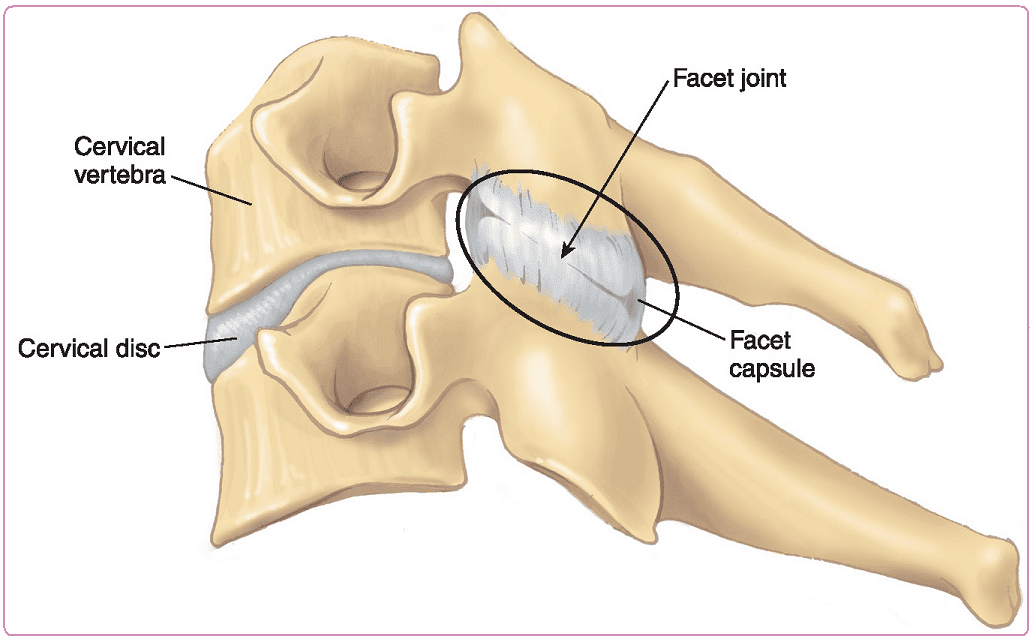
Each vertebra in your spine has four facet joints, an upper and a lower pair. These joints link the back of the spine together. They are designed to provide stability and control motion between the vertebrae. At each facet joint there is not a lot of movement, however, when all the facet joints are linked together they contribute to a significant amount of movement of the spine and allow complex movements such as flexion, extension and rotation of the spine.
There are a number of potential causes of facet joint pain. The facet joints may be irritated by trauma, repetitive movements, or arthritic changes. It is very common to develop degenerative changes in facet joints after trauma to the spine, as a result of an injury to the intervertebral disc or secondary to degenerative disc disease. When the intervertebral disc is injured, the cushioning effect of the disc is lost. This then places more stress onto the facet joints as there is less space between their articulating surfaces and may result in degeneration. Pain sensitive nerve endings can be found in the capsule of the facet joint and are triggered by inflammation.
Poor posture can also cause undue stress on the facet joints. There is a natural curve in the cervical (neck) section of the spine called the cervical lordosis. In this natural position, the facet joints in the neck are designed and positioned to handle a certain amount of force. When the natural curve of the neck is exaggerated, more forces are placed on these joints.
Symptoms
Pain arising from the cervical facet joints is usually at the level of the affected joint(s), but can refer pain to other areas of the body including the shoulders, arms and upper back. Generally the pain is a dull achy pain, made worse by activities that put pressure on these joints i.e. looking upwards and “extending” the neck. Stiffness and a lack of movement is also usually noted.
Diagnosis
Most cases of facet joint pain are diagnosed by a good medical history and physical examination. X-rays of the neck may be used to help rule out degenerative changes in the facet joints or degenerative disc disease if suspected.
Treatment
The majority of the time cervical facet joint pain is treated without surgery. Treatment may involve hands-on physical therapy from a qualified practitioner such as a Chiropractor, Osteopath or Physiotherapist. Methods of treatment used may include joint mobilisation, manipulation, exercise, and education on good spine posture. Your GP may also provide anti-inflammatory medications, pain medications and activity modification advice.
In some cases these treatments may not be effective, other options such as facet joint injections may be required. Radiofrequency neurolysis can be used; this is a procedure which blocks the pain messages transmitted by nerves that supply the affected facet joint. Surgery is rarely required.
Most individuals with facet joint pain will recover fully and return to normal activities. Ensuring correct posture both at work and play, alongside a gentle neck stretching and strengthening regime will help to prevent future episodes of pain.
Research indicates that a combination of spinal manipulation and exercise added to GP best care advice is the most cost effective form of treatment for non-specific neck pain (Bronfort et al, 2012. NICE, 2015). This is also confirmed by the NHS Evidence Service recommended plan of action for the treatment of non-specific neck pain. Thoracic spine manipulation is also recommended for reducing pain and disability in patients with neck and neck-related arm pain (Gonzalez-Iglesias J. et al, 2009).
At our ten Blackberry Clinics nationwide we have many experienced practitioners who treat neck, joint and back pain. If you do not respond to manual therapy they may refer you to one of our musculoskeletal or pain management doctors who specialize in interventional treatment such as radiofrequency denervation. Even if you have had neck pain for a long time there may be a solution to your problem at Blackberry Clinic. Check out our website on www.blackberryclinic.co.uk for more information about all the treatments on offer.
References
Bronfort G, Haas M, Evans R, Leininger B, Triano J: Effectiveness of manual therapies: the UK evidence report. Chiropr Osteopat 2010, 18:3.
Bronfort G, Evans R, Anderson AV, Svendsen KH, Bracha Y, Grimm RH. (2012). Spinal manipulation, medication, or home exercise with advice for acute and subacute neck pain: a randomized trial. Annals of Internal Medicine. 156 (1), 1-10.
Gonzalez-Iglesias J, Fernandez-de-las-Penas C, Cleland JA, Gutierrez-Vega MR: Thoracic spine manipulation for the management of patients with neck pain: a randomized clinical trial. J Orthop Sports Phys Ther 2009, 39:20-27.
Gross AR, Hoving JL, Haines TA, Goldsmith CH, Kay T, Aker P, et al.: Manipulation and mobilisation for mechanical neck disorders. Cochrane Database Syst Rev 2004, CD004249.
National Institute for Health and Care Excellence (2016) Non-Specific Neck Pain. Available at: https://cks.nice.org.uk/neck-pain-non-specific#!topicsummary [Accessed 20 November 2018]