

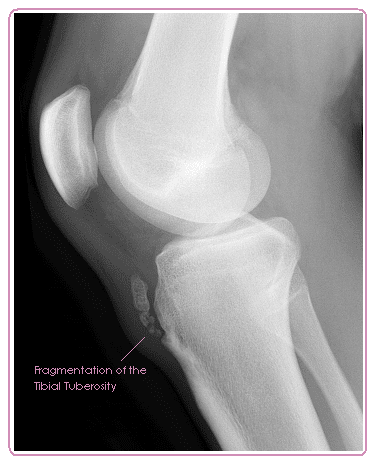
At Blackberry Clinic we treat a huge variety of musculoskeletal conditions causing pain and discomfort. Knee pain can be caused by very many different factors, but in young and physically active teenagers the diagnosis is often a condition called Osgood Schlatter disease, also known as osteochondrosis or traction apophysitis of the tibial tubercle. This is one of the most common causes of knee pain in the skeletally immature, adolescent athlete. It is a disorder (not really a ‘disease’) of the lower front of the knee where the large tendon from the base of the kneecap attaches to the bone of the leg below.
Intense knee pain is usually the presenting symptom that occurs during activities such as running, jumping, squatting, and especially ascending or descending stairs and during kneeling. The pain can be reproduced by extending the knee against resistance, stressing the quadriceps, or striking the knee.
It is so important to get an accurate diagnosis so that the right treatment plan can be implemented and the patient can start making a full recovery.
Thanasis, one of our physio team at Blackberry Clinic Milton Keynes, explains here what Osgood Schlatter disease is and what the symptoms might be.
What is Osgood Schlatter disease?

Osgood Schlatter disease is an overuse injury, it occurs secondary to repetitive strain and microtrauma from the force applied by the strong patellar tendon at its insertion into the relatively soft apophysis of the tibial tubercle.
Risk factors associated with development of Osgood-Schlatter disease
• Age — Osgood-Schlatter disease is more common in children undergoing growth spurts, with symptoms peaking in boys at about 12–15 years of age, and girls at about 8–12 years of age.
• Sporting activity — children active in sports that include running, jumping, and repetitive bending of the knee are at greater risk of developing Osgood-Schlatter disease. Early sports specialization increases this risk further.
• Biomechanical risk factors such as quadriceps muscle tightness and reduced flexibility of hamstring muscles, in particular, shortening of the rectus femoris.
Symptoms typically settle over weeks or months but occasionally may persist for 1–2 years before resolving completely in 90% of people.
Osgood Schlatter disease can be diagnosed clinically, and radiographic evaluation is usually not necessary.
Treatment of Osgood Schlatter disease
The suggested treatment of Osgood Schlatter disease depends on the intensity of the symptoms and the physical findings on the assessment.
The management may include activity modification and relative rest from inciting activities in association with core and lower extremities exercise, as well as ice packs, NSAIDs medication, supplements and knee pads. About 90% of patients respond well to non-operative treatment that includes rest from aggravating activity, icing after activity, activity modification and rehabilitation exercises, all of which can be given and advised by musculoskeletal specialists such as Chiropractors, Osteopaths and Physiotherapists. It should not be necessary to stop all exercise since children can be disheartened by this unnecessary approach.
Significant benefit can be obtained by assessment by a Podiatrist. Overpronated (flattened) feet are frequently associated with Osgood-Schlatter disease and relief using orthotic shoe insoles to control the rolling of the foot can be almost immediate. At Blackberry Clinic our Phits trained experts, Shelley Terry and Milly Dalton can prescribe Phits Orthotics if gait analysis and assessment evidence that these may be useful.


_________________________________________________________________
Literature reviewed:
• Osgood Schlatter Disease, Smith et al, 29 July 2020. https://www.ncbi.nlm.nih.gov/books/NBK441995/
• https://cks.nice.org.uk/topics/osgood-schlatter-disease/
https://www.ncbi.nlm.nih.gov/books/NBK441995/