

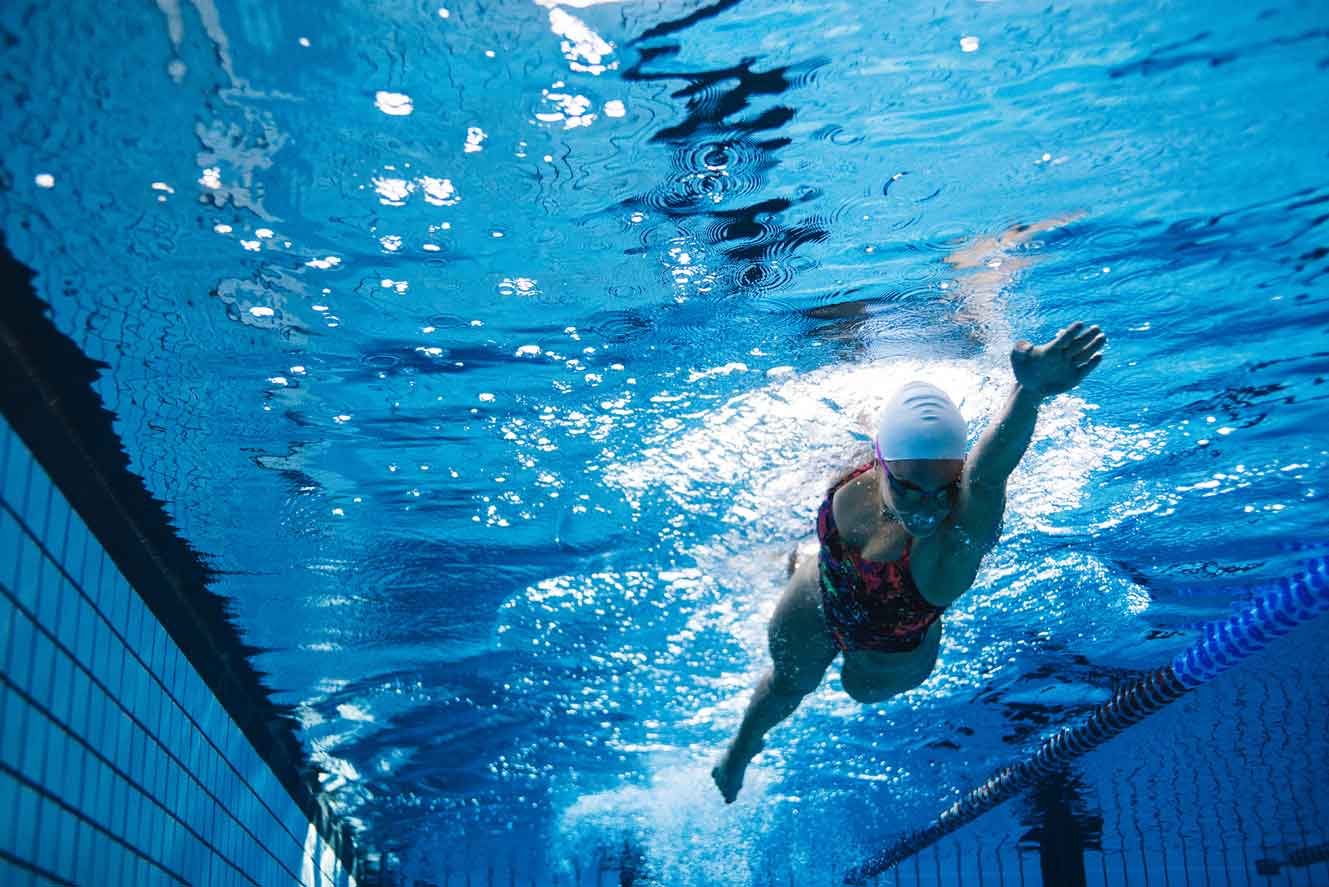
With the news that gyms and swimming pools are to be reopening shortly we are taking a look at common injuries in swimming. Any unaccustomed exercise can lead to over use injuries and discomfort. By recognising the signs these injuries can be prevented so that your long awaited swimming session can be a pleasure rather than a pain.
The shoulder joint is a complex joint and one commonly injured in swimming.
Overuse and the seemingly endless repetition of arm rotations seems like an inevitable prescription for shoulder pain, but when you have proper shoulder alignment and posture you can significantly reduce the chances of injury. Three key areas for injury prevention include your stroke, your body and your training.
YOUR STROKE
Repetition alone isn’t enough to injure your shoulder, but repetition of a bad technique definitely is. Correcting your technique is not actually that difficult, but you do need to know what to look out for and, just as importantly, work diligently to improve in these areas. Video analysis is a great tool, because it really helps you identify what you personally need to work on. Get some
instruction from a coach or have a friend film you to see where you are going wrong.
FOUR STROKE TECHNIQUE TIPS TO HELP AVOID DEVELOPING SWIMMER’S SHOULDER INCLUDE:
1. Body Rotation: Developing a good, symmetrical body rotation through the development of an efficient bilateral breathing pattern is key to removing shoulder injury. Swimming with a flat body in the water with limited rotation along the long axis of the spine causes the arms to swing wide around the side during the recovery phase. This swinging action results in large amounts of internal rotation at the shoulder joint which is the major source of impingement and rotator cuff issues.
2. Hand Placement into the Water: A hand pitch outwards with a thumb first entry into the water leads to excessive internal rotation which, can eventually lead to acute pain in the shoulder as an ‘over-use’ injury. Instead of entering the thumb first, change your technique to enter with a flat hand, finger-tip first.
3. High Elbow Catch: Without the use of video analysis, many swimmers are unaware of how they pull through under the water. Typically, swimmers will pull through with either a dropped elbow or with a very straight arm. Doing this, will load the shoulder muscles excessively as the majority of the pull through phase is spent pushing down, rather than pressing back. Working to develop a ‘high elbow catch’ technique utilises the larger, more powerful muscle groups of your chest and upper back, rather than relying upon the shoulders.
4. Hand Entry in Line with the Shoulder: At the point of hand entry often swimmers allow the hand to cross the midline of the body, this causes impingement in the front of the shoulder. Likewise, during pull through the hand should not pass the midline if your stomach/chest. Visualise an imaginary line cutting through your body into a left and right half. Make sure that during
hand entry and pull though the hand doesn’t cross over onto the other side.
To read about the other key areas for injury prevention, your body and your training, click on the link to download a comprehensive advice leaflet with tips and techniques to keep you in the water.