

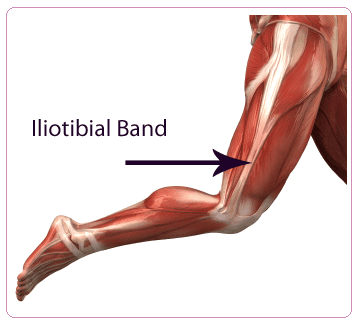
THE INJURY
Iliotibial band syndrome (ITBS) is another common cycling injury, but is often lost among other knee pain injuries due to the location of the pain frequently presenting on the outside of the knee. ITBS is typically associated with prolonged, repetitive activity which explains why it’s so common in cyclists. Symptoms include pain on the outside of the knee (often a sharp stabbing pain), tenderness and sometimes swelling. In some cases, pain is felt simply walking or going up and down stairs. You may feel stiff or tight after periods of inactivity. This annoying and painful injury can quickly become crippling if not addressed and corrected.
The ITB is a tendinous fascial band that originates on the iliac crest (hip bone) and attaches to the outside of the knee. As such it runs over two joints – the hip and the knee. When your knee bends and straightens repeatedly, the band can become inflamed by rubbing over bony condyles. Other contributing factors may include tightness of thigh (frequently the quadriceps and hip flexors), hip and buttock muscles as well as weak pelvic stabilising muscles.
MANAGEMENT AND REHABILITATION
Most people mistakenly believe that ITBS occurs because of a tight IT band — but the IT band is supposed to be tight to do its job. The source of the problem is almost always weak hip and buttock muscles. Weak gluteus muscles result in excessive side-shifting or lateral movement of the pelvis which causes your femur (thigh bone) to move abnormally, the resulting outcome being unusual loading of the supportive IT band, ‘pulling’ it away from your knee.
Over-pronation and a leg-length discrepancy can also be contributing factors. Many cyclists find that as fatigue sets in, their ankles or knees collapse inwards, which in turn pulls on the IT band, forcing it to rub against that bony condyle on your knee. This re-enforces the importance of having strong legs and pelvis to prevent injury. The same thing happens when the core muscles start to fatigue. This can managed and prevented by ensuring a strong core, including the lower back, and gluteal muscles. A regimen of icing and anti-inflammatories will assist in reducing pain. A foam roller can be used to loosen up tight structures, as can regular massage. Physical therapy treatments will work on releasing structures that are shortened and tight – movement-based treatment for soft-tissue injuries will break up scar tissue and restore normal function. Ease off on the volume and intensity of training, or take a complete rest if that is advised and cross train to keep fit.
PREVENTION
BODY CONDITIONING TIPS
Strengthening exercises for the hip abductors, core and gluteal muscles can be prescribed by your physical therapist along with a stretching programme. Exercises may include squats, lunges, plank, side plank, Romanian twists, superman, deadlifts and Pilates-type exercises which incorporate lower limb, core and pelvic control often using Swiss balls.
BIKE SET UP TIPS
Ensure your seat is at the optimal height for your body. If you pronate (are flat footed) you may need orthotics or a wedge inside your cycling shoe to stop the leg and knee rotating inwards putting further tension on the ITB. Tucking the knees in too tight, to increase streamline, will also add tension and greater friction to the ITB.
The information contained in this article is intended as general guidance and information only and should not be relied upon as a basis for planning individual medical
care or as a substitute for specialist medical advice in each individual case. ©Co-Kinetic 2018/Blackberry Clinic 2021